Essential Skills at Work
The Skills Behind the Work
Think about the last hour of your workday.
Maybe you read an email and figured out what someone was actually asking you to do. You adjusted your priorities when something unexpected came up. You entered information into a digital system, calculated a cost, explained something to a colleague, solved a problem, or learned how to do something you had never done before.
Chances are, you used several “essential skills” without giving them much thought.
That is part of what makes these skills so interesting—and so important. They are woven into almost everything we do.
Each September 17, Skills for Success Day raises awareness about the skills people need to succeed in learning, work and life. The Government of Canada’s Skills for Success framework identifies nine: reading, writing, numeracy, digital, problem solving, communication, collaboration, adaptability, and creativity and innovation.
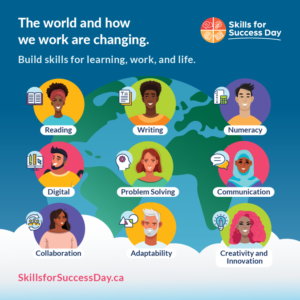
These skills are foundational because they support our ability to learn and apply other skills. They also help us evolve alongside our jobs, respond to new expectations and technologies, and adapt as the world of work changes.
And while we may call them foundational, that doesn’t mean they are simple.
The Skills Behind the Job
Consider a construction worker interpreting measurements and adapting when conditions on a job site change.
A personal support worker reading care instructions, documenting information accurately, communicating with a family member, and responding to an unexpected situation.
A restaurant employee calculating an order, using a point-of-sale system, collaborating with coworkers, and managing several competing demands at once.
Or an office employee learning a new piece of software while determining whether the information generated by it actually makes sense.
Different jobs. Different environments. Different technical expertise.
But underneath them are many of the same essential skills, and that is exactly the space where our Get SET (Skills, Education, Training) programs work.
Across Ontario, Get SET programs support more than 46,000 adults each year to strengthen the foundational skills they need for learning, work and life.
The learning is practical and connected to what someone actually needs to do—whether that means understanding workplace documents, using digital tools, communicating effectively, working with numbers, solving problems, preparing for further training, or building confidence with unfamiliar tasks.
These aren’t skills for just one occupation.
They travel with us from job to job, role to role, and throughout our working lives.
Foundational Doesn’t Mean Elementary
One of the challenges in talking about foundational or essential skills is that they can sometimes be mistaken for beginner skills.
But foundational does not mean simple.
Problem solving becomes more complex as our responsibilities grow. Communication changes depending on the audience, environment, and stakes. Digital skills continually evolve. Adaptability becomes particularly important when workplaces introduce new technologies, processes, or expectations.
Reading, writing and numeracy are embedded in countless workplace tasks—from understanding safety information and completing documentation to interpreting data, following technical instructions, managing inventory or calculating materials.
This is true even in highly technical occupations.
More than 5,000 learners in Get SET have apprenticeship goals. For someone preparing to enter or advance in the skilled trades, foundational skills can show up everywhere: reading technical drawings and safety information, calculating measurements, completing documentation, communicating on a job site, solving unexpected problems, or adapting to new equipment and technology.
The Skills That Help Us Keep Moving
On Skills for Success Day, perhaps the opportunity is to look a little more closely at the skills behind the work happening all around us.
As jobs change, technologies evolve and people move through different roles over the course of their working lives, the ability to keep learning matters. And that ability rests, in large part, on strong foundational skills.
Across Ontario, Get SET programs help people strengthen that foundation—not simply to prepare for their next job, but to navigate change, pursue new opportunities and continue growing once they get there.
Because essential skills aren’t just the skills we need to get to work.
They’re the skills that help us keep moving forward.
Contributor: Rachel Crane, Executive Director at Learning Link