Get SET Support for Newcomers
Where Do We Fit?
Some newcomers need to develop their English-language skills. Others can communicate in English but need to strengthen their reading, writing, math, digital or workplace skills to reach their goals. Some need both.
Choosing the right referral starts with understanding whether someone needs language training, foundational skills upgrading or both. With several options available, knowing when to refer a newcomer to English as a Second Language (ESL), Language Instruction for Newcomers to Canada (LINC) or Get SET (Skills, Education and Training) isn’t always straightforward.
Although services vary across Ontario, understanding the core differences between these programs can help you connect newcomers with the right support.
This article explores those differences, explains why a referral to Get SET isn’t always clear-cut and provides practical guidance for making decisions.
Note: For French-language learning and support, options include French as a Second Language (FSL), Cours de langue pour les immigrants au Canada (CLIC) and French language Get SET programs.
Get SET – A Bit of Background
Get SET programs are funded by the Ministry of Labour, Immigration, Training and Skills Development. MLITSD Get SET guidelines state that service providers must ensure each learner is sufficiently proficient in speaking and listening to benefit fully from the language of Get SET instruction (English or French). The guidelines no longer recommend a specific Canadian Language Benchmark (CLB) entry level. Previously, CLB level 6 in speaking and listening was recommended but that recommendation was removed in December 2023.
Language ability is more complex than a single language level. However, without a specific CLB recommendation, it can be more challenging for Get SET programs to determine who they can support and for community partners to know when and where to refer.
At the same time, changes in the availability of ESL and LINC programming have created additional challenges in some communities. Reduced access to certain language-training levels can leave newcomers needing more language development before they are ready to benefit from Get SET.
This has resulted in some newcomers finding themselves caught between programs. They need additional language training before they can fully benefit from skills upgrading in a Get SET program, but they may not have access to local language training options.
ESL, LINC and Get SET: Which Program is the Right Fit?
ESL and LINC support learners who are learning English as a new language.
Get SET assists individuals who already communicate in English or French but have a goal of building core foundational skills.
Foundation skills could include reading, writing, math, digital, communication, and/or workplace skills
This chart breaks things down in more detail.
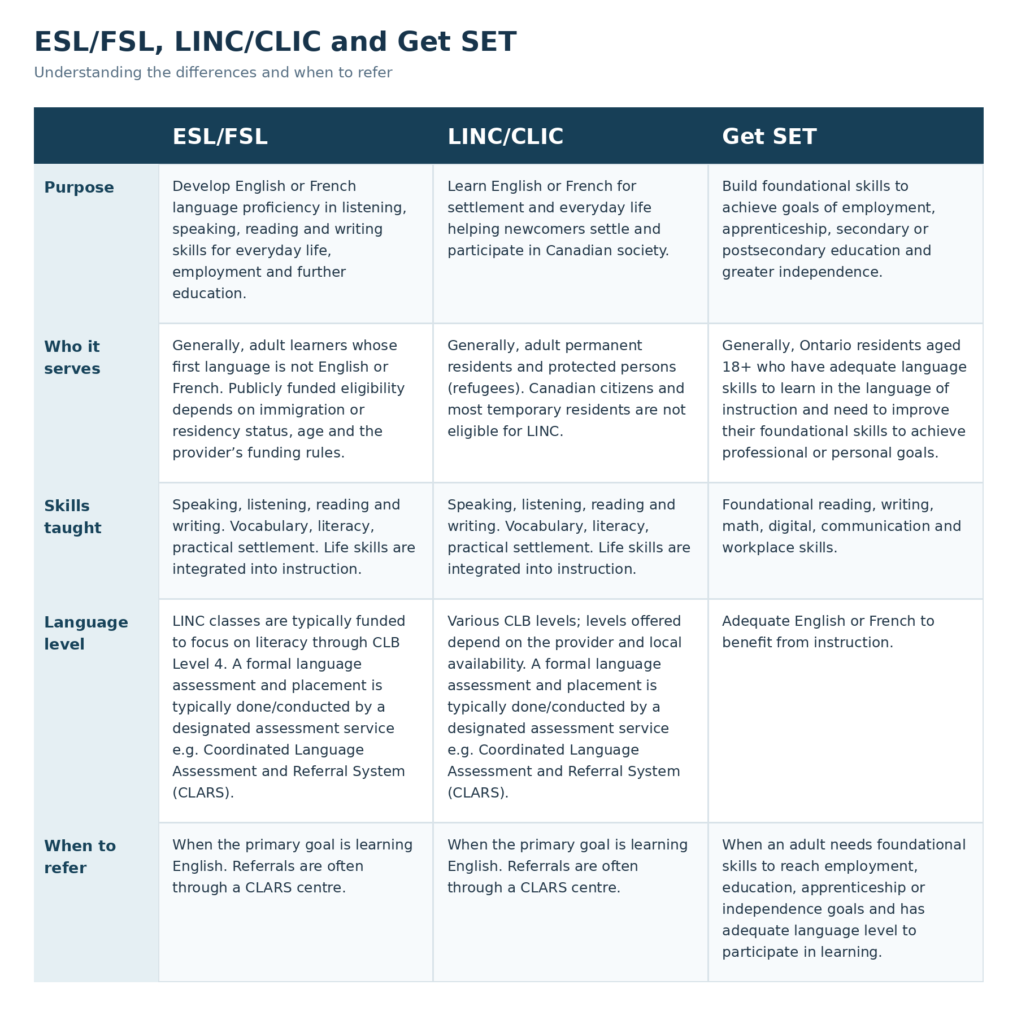 Note: These free, publicly funded options are available for eligible learners in all three programs, but availability may vary. Program purposes can also overlap, and a learner may need both language development and foundational skills support. Online options are available for all three programs, although availability varies by location and provider.
Why Isn’t There a Simple CLB Requirement for Get SET?
Canadian Language Benchmark (CLB) levels provide useful information about language ability, but it is only one part of deciding whether Get SET is a good fit. Programs also consider the learner’s goals, existing skills, learning needs and available supports alongside their language abilities.
Language abilities are assessed separately in four areas: speaking, listening, reading and writing. Someone may have strong conversational skills but struggle with reading or writing.
For example, consider three newcomers with different learning needs:
- Learner A wants to improve conversational English for everyday situations. Language training may be the best fit.
- Learner B communicates comfortably in English but needs math and digital skills to prepare for an apprenticeship. Get SET may be a good fit.
- Learner C has speaking and listening skills at CLB 5 but reading and writing skills at CLB 2. Whether Get SET is appropriate will depend on their goals, the training offered and the supports available. Additionally, continued language training may also be beneficial.
At Get SET, rather than asking only, “What are their CLB levels?” we ask:
“Can this person benefit from this Get SET program at this point in their learning?”
Get SET programs consider the whole picture, including language abilities, goals, existing skills, learning needs and available supports.
Making a Referral
You don’t need to determine Get SET program fit on your own.
These three scenarios can help guide your next steps.
- Primary need: Learning English or French
Consider: ESL/FSL or LINC/CLIC, depending on eligibility.
Next step: Reach out to the providers in your area. If a language assessment has not been completed, refer the individual to a Coordinated Language Assessment and Referral System (CLARS) centre.
- Primary need: Skills upgrading
Consider: Get SET.
Next step: Contact your local Get SET provider to explore available training options if the individual has enough English or French to discuss their goals and participate meaningfully in learning.
- Not sure which program is the right fit?
Start a conversation with your local Get SET provider about the learner’s goals, language abilities and skills needs. The provider can help explore whether the training they offer is a good fit. If another service is needed, it can also help identify community or online options.
If you are not familiar with the Get SET providers in your community, please reach out to the Learning Network in your region for assistance.
What Happens When You Refer to Get SET?
When you refer someone to Get SET, the program will:
- Discuss their goals: Explore what the individual wants to accomplish and the skills they need.
- Assess their skills: Determine their current abilities and learning needs.
- Determine program fit: Identify whether Get SET can provide meaningful support.
- Explore other options: Help identify another community or online resource when Get SET isn’t currently the right fit.
- Follow up: Communicate with the referring partner, where appropriate and with the learner’s consent.
 A “No” Today Doesn’t Mean “No” Forever
 A “No” Today Doesn’t Mean “No” Forever
Language skills develop, goals change and circumstances evolve. Someone who isn’t ready for Get SET today may be a good fit in the future.
When in doubt, reach out. We would rather have a conversation than have someone miss a service that could help.
Find your local Get SET program through our network. Lets start the conversation.
Contributor: Carrie Wakeford, Executive Director at Learning Ontario Central South
Contributor: Robyn Cook-Ritchie, Executive Director at Laubach Literacy Ontario
Contributor: Heather Robinet